
1824
In 1824, Hume and Hovell became the first Europeans to pass through the Bonnie Doon area. Until then there had been only a few wandering Koori clans who seldom stayed long, catching kangaroo, possum, fish, yams and white grubs. By the 1850s, a few station owners had taken up large tracts of land from Government leasehold. The owners had to hire shepherds to mind their sheep as there were no fences or roads. The sheep were yarded at night as the wild dogs were numerous. As more settlers arrived the land was further sub-divided into sizeable properties under the close Settlement Act..
A excerpt from ‘The Bridge’ marking the Bi-Centennial year of this original 1824 journey …
Autumn Edition, Vol 18: Issue 3 (page 12)
This year marks the bicentennial of Alexander Hamilton Hume and William Hilton Hovell’s ‘expedition of discovery’ in 1824, our flashback recounts two explorers of the past who travelled this area over 200 years ago. They rested briefly on December 2nd, 1824, at a spot which is now is landmarked by a monument at the intersection of Growlers Gully Rd and Maroondah Hwy, Merton.
The original 1824 Hume & Hovell expedition started out as an exploration for new grazing lands for the early settlements. The party started from Hume’s home in Appin, NSW and they travelled south through the western side of the great Dividing Range ending up on the Victorian coast. “They had three saddle horses, five bullocks, pulling two cartloads of supplies and six convicts…” (Gillison 1974, p 23) going on to detail the supplies ‘arms, gun powder cartridges, a woollen tent, 1200 lbs of flour, 350 lbs salt pork, 170 lbs of sugar, 20 lbs of salt, 30 lbs of tea and coffee, 16 lbs of soap, 8 lbs of tobacco and one blanket each.’
It was in the December 1824 that Hume & Hovell travelled through the Mansfield Shire and realizing that their supplies would not last through to their original destination in South Australia, they turned towards Port Phillip. Whilst passing through the area it was said that Hume & Hovell saw “Mt Battery” in the distance and named it that from afar, due to – its appearance of ‘earth works thrown up for mounting guns’. It is also reported that Hovell mistakenly thought that they had arrived at Western Port, but in fact they were in Corio Bay – which is now, Geelong.
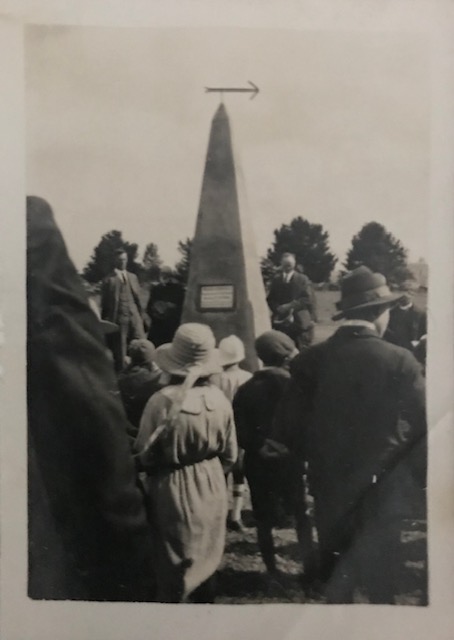
and Maroondah Hwy, Woodfield. Brankeet school can just been seen in the background on the right.
In 1924, the centennial year; a committee was formed to co-ordinate celebrations along the route in which they unveiled monuments erected to remember the expedition 100 years before. The celebrations were from Albury to Corio Bay from15 – 21 November in 1924 and the local plaques commemorating the journey stand in “Barjarg and Brankeet” as noted by Historical Aspects of Bonnie Doon.
Some 200 years on from this journey, Mt Battery as still towers on the horizon, looking down and it was pointed out by Gillison (1974) that “Mt Battery, rising above the well-watered timbered valleys and encircled by hills and mountains was the home of the Youngillim tribe of Aborigines. Numbering some hundreds they had roamed this excellent hunting ground for uncounted years.” This citation reminding us that this story has its own limitations, and also of limitations of history past. This story by no means encapsulates a full historical perspective, or perspective of the shared history with traditional owners of this region, but merely, it recounts one small aspect of time. For those interested to keep an eye on the potential observing of the bicentennial of this noted journey later this year.
References:
Gillison, J., 1974, Colonial Doctor and his Town, Cypress Press, Australia
Historical Aspects of Bonnie Doon 1978, The Early Years, p.22, Mansfield Courier, Mansfield, Victoria & Biggs Printing Service Shepparton, Victoria
Monuments Australia 2024, Hume & Hovell, Available at: www.monumentsaustralia.org.au/themes/people/exploration/display/33392-hume-and-hovell, (Accessed 07/07/2024)
TLAWC 2024, Taungurung Introduction, Available at: https://toolangicastellahistory.org.au/about/taungurung/ (accessed 07/07/2024)
This story acknowledges the Taungurung people as the traditional owners of the land and pays respect to the Taungurung Elders, past, present and future and extends that respect to all Aboriginal and Torres Strait Islander peoples.
 Bonnie Doon Community Group